Valentine’s Day is the time of love and Hallmark cards. All over the world, couples dedicate cheesy gifts to each other, and racks of chocolates and heart-shaped things fly off the shelves. Kids in elementary school trade valentines, putting special care into decorating their mailboxes. CVS employees stare into the faces of young men that scramble around the store, just before closing.
This all sounds familiar. However, Valentine’s Day is more than just a commercial holiday. I mean mostly.
These traditions, believe it or not, actually came from somewhere.
The Strange Story of Lupercalia…
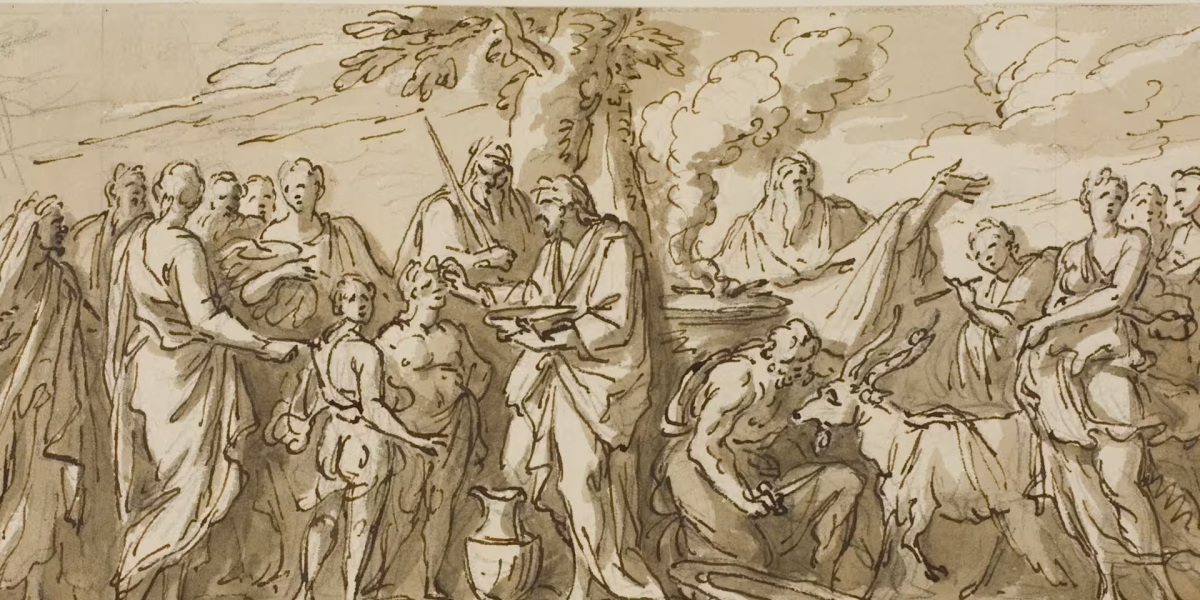
The true origin of Valentine’s Day is definitely foggy. However, most people consider it to have derived from a very similar Roman holiday, Lupercalia. Lupercalia was celebrated in mid-February as a celebration of the coming spring. However, it was quite different. The festivities started when 2 Luperci, or special Roman priests, sacrificed goats and a dog. Once the sacrifice concluded, they would use the bloody knife to smear markings on their foreheads. Finally, a milk-soaked piece of wool would be used to remove the blood and the men would laugh. As part of the ceremony, the men were literally required to laugh. After a great Lupercal feast, the meat of the sacrificed goats would be cut up and divided among men in the community who would run around, hitting any women they encountered as a way of warding off bad spirits and promoting fertility. As part of another Lupercalia tradition, men would pick names of women from a jar and spend the festival with their pairs. Sometimes, these pairs would end up staying together for life.
This doesn’t exactly sound like the pink and red hearts, candy, boxes of chocolates, teddy bears, and XOXO holiday we know and love today, though.
Lupercalia celebrations were done to ward off evil spirits with the coming of spring. There is no known origin of these festivities. However, they have been dated back to 6th century B.C.E. The holiday evolved every year, while still keeping the same central ideas of fertility and romance. Eventually Roman Catholic leaders started to ban pagan worship and rituals. It wasn’t until 494 C.E when Pope Gelasius I finally got rid of the holiday completely. After that, some believe that the holiday was converted into Candlemas, a Catholic holiday celebrating the Virgin Mary. On the other hand, people consider the beginning of St. Valentine’s Day in 496 C.E by Gelasius to truly account for the holiday that we know today.
Who is Saint Valentine, anyway?
The most well-known story goes that in 3rd century B.C.E, a man named Valentine was imprisoned and later executed for secretly marrying Christians who were in love. During his imprisonment, Valentine attempted to convert Roman Emperor Claudius II to Christianity. When Valentine himself was forced into rejecting his own faith, he chose death and was beheaded.
The same legend also tells the tale of Valentine and his prisoner’s blind daughter, Julia, whom he befriended. According to the legend, God restored her sight after praying with Valentine. Apparently, Valentine wrote a note to Julia and ended it with, “From your Valentine.” This might be the inspiration for passing “Valentines” on the special day.
Despite the vagueness surrounding the man who we know as St. Valentine, he was declared a saint by the Catholic Church, being martyred on February 14th.
St. Valentine was later known as a patron of love and romance, despite Pope Gelasius originally not intending to make the holiday about anything of the sort.
The Holiday We Know and Love Today…
Certain symbols of Lupercalia still remain in the holiday that we celebrate today, or rather, tomorrow. The color red could symbolize the original blood sacrifice. White would be from the milk and cloth used to clean off the blood in the ceremony of new life.
Lupercalia is no longer mainstream anymore, for relatively obvious reasons, and the holiday has taken an entirely different direction.
We still call it “Valentine’s Day” to denote the patron of love, whose name likely won’t ever be forgotten, despite it originating from a completely different type of holiday.
We have certainly gone a long way from sacrificing all of those innocent dogs and goats.
Movies have been made; love songs have been sung to accompany this occasion, year after year.
Valentine’s Day is now a more commercialized holiday. Compared to the past, shoppers are spending a lot more on the holiday. People in the U.S spend an estimated 29 billion dollars total on all things Valentine. This includes products such as candies, items, and other gifts and foods. Costumers spend an average of $200 alone on this special day.
Some dislike the holiday, finding it expensive and commercially disgusting as it forces people to conform to romantic ideals. Others appreciate the economic boom for businesses surrounding them. A majority of people mark their calendars and get ready for a day full of love and sweetness.
Personally, I have similar feelings about Valentine’s Day as I do about New Years Resolutions: it can be stupid sometimes and make people feel bad about themselves, however, if a holiday is the only way you can get yourself to change, whether that be sharing love and appreciation to those around you or improving your life, by all means, knock yourself out.
If love is going to be annual, go all out. There are bigger problems than a little extra kindness going around.